
What It Is
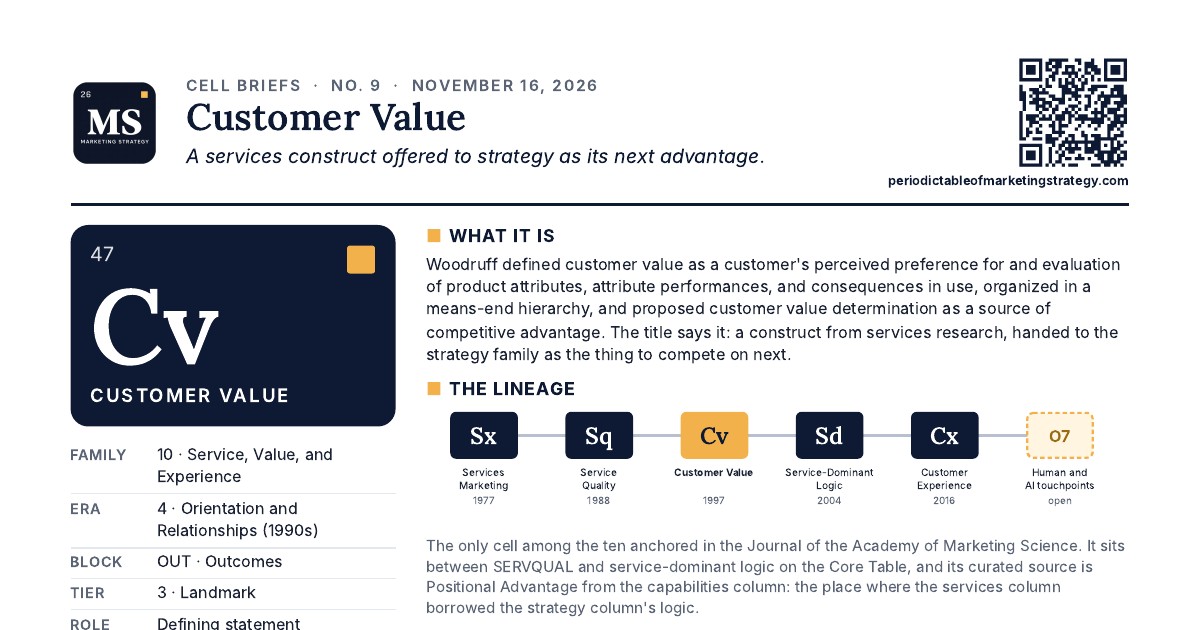
Woodruff defined customer value as a customer's perceived preference for and evaluation of product attributes, attribute performances, and consequences in use, organized in a means-end hierarchy, and proposed customer value determination as a source of competitive advantage. The title says it: a construct from services research, handed to the strategy family as the thing to compete on next.
The Lineage
- Sx
Services Marketing
1977
- Sq
Service Quality
1988
- Cv
Customer Value
1997
- Sd
Service-Dominant Logic
2004
- Cx
Customer Experience
2016
- O7
Human and AI touchpoints
open
The only cell among the ten anchored in the Journal of the Academy of Marketing Science. It sits between SERVQUAL and service-dominant logic on the Core Table, and its curated source is Positional Advantage from the capabilities column: the place where the services column borrowed the strategy column's logic.
Where It Travels
One curated link out, to Customer Equity and CLV (value equity in the customer equity model is customer value as defined here), plus 11 deep-dive mentions in seven families: market-driven strategy, the customer value-based theory of the firm, value-based marketing, the loyalty effect, enduring customer value, physical distribution service, and outside-in strategy.
What It Rests On
One curated link in, from Positional Advantage (Pa). The anchor cites 12 other anchor works, among them Day (1990, 1994), Dwyer, Schurr, and Oh (1987), Griffin and Hauser (1993) on the voice of the customer, Zeithaml (1988), and both market orientation anchors. It is a strategy paper that happens to be about value.
Descendants You Would Not Guess
Eleven anchor works in seven families cite it: Supply Chain Orientation (Mentzer, Flint, and Hult, 2001), Brand Portfolio (Morgan and Rego, 2009), Market-Driven Firm Capabilities (Vorhies, Harker, and Rao, 1999), Trust, Value, and Loyalty (Sirdeshmukh, Singh, and Sabol, 2002), Quality, Value, and Satisfaction (Cronin, Brady, and Hult, 2000), Customer Channel Migration (Ansari, Mela, and Neslin, 2008), Demand and Supply Integration (Esper et al., 2010), and Critical Service Logic (Grönroos and Voima, 2013).
Three Things The Cell Does Not Show
- Strategy in, strategy out. Its only curated source is Positional Advantage, and three of its mentions are strategy deep-dive cells (market-driven strategy, the customer value-based theory of the firm, value-based marketing). It is the services column's most strategic cell.
- Same cell, two stories. On the Core Table it sits between SERVQUAL and S-D logic. In the deep dive it sits in "Satisfaction and Value in Services," between Zeithaml's price-quality-value model (1988) and the quality-value-satisfaction effects of Cronin, Brady, and Hult (2000), then transformative service (2013).
- Its most surprising heirs are logistics. Three supply chain cells (logistics service quality, physical distribution service, demand and supply integration) adopt the means-end hierarchy for business-to-business service value.
Anchor Works
Cite as: Hult, G. Tomas M. (2026), “Customer Value,” Cell Briefs No. 9, The Periodic Table of Marketing Strategy.
Link counts and citing works are from the site's analysis dataset (Version 1.0). Placements, anchors, and tiers are editorial judgments; verify against the original works.
Copyright © G. Tomas M. Hult 2026