
What It Is
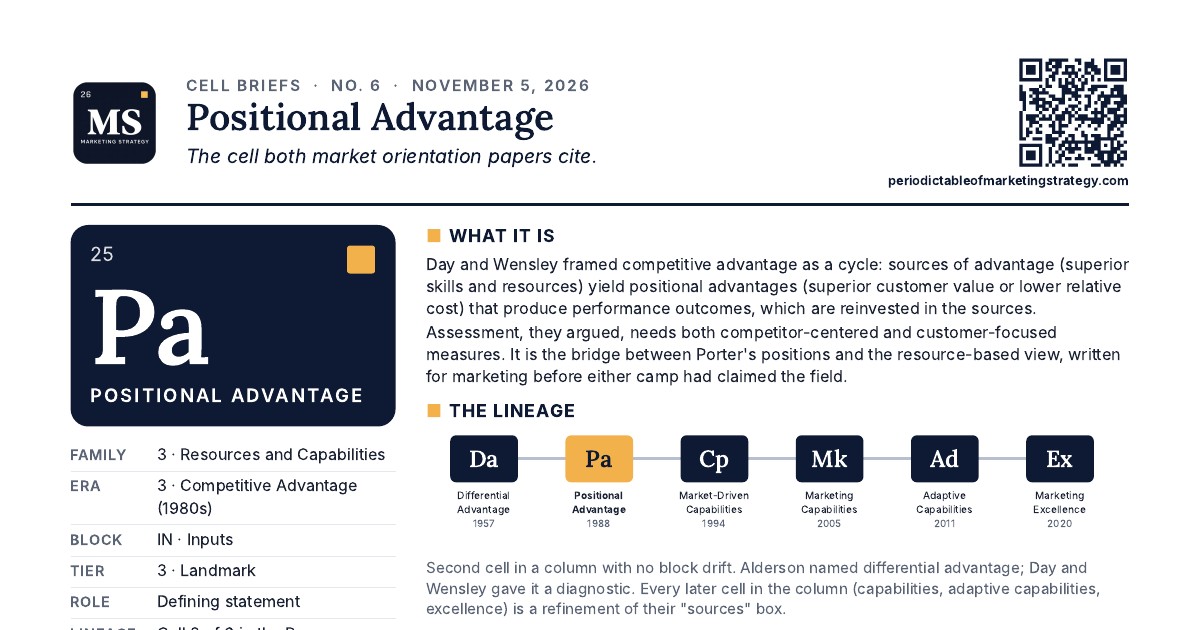
Day and Wensley framed competitive advantage as a cycle: sources of advantage (superior skills and resources) yield positional advantages (superior customer value or lower relative cost) that produce performance outcomes, which are reinvested in the sources. Assessment, they argued, needs both competitor-centered and customer-focused measures. It is the bridge between Porter's positions and the resource-based view, written for marketing before either camp had claimed the field.
The Lineage
- Da
Differential Advantage
1957
- Pa
Positional Advantage
1988
- Cp
Market-Driven Capabilities
1994
- Mk
Marketing Capabilities
2005
- Ad
Adaptive Capabilities
2011
- Ex
Marketing Excellence
2020
Second cell in a column with no block drift. Alderson named differential advantage; Day and Wensley gave it a diagnostic. Every later cell in the column (capabilities, adaptive capabilities, excellence) is a refinement of their "sources" box.
Where It Travels
Six curated links out, second only to Market Orientation: Resource-Advantage Theory, Customer Value, Brand Equity, Enviropreneurial Marketing, Market-Based Assets, and Sustained MO Advantage. Eleven deep-dive mentions in ten more places, from the value chain and logistics capabilities to export venture performance and corporate environmentalism.
What It Rests On
Two curated links in, from opposite ends of the table: Competitive Positioning (column 1; Porter's positions restated as outcomes of skills and resources) and Market Share Effect (column 18; PIMS measures as the performance side of the cycle). Its reference list reaches back to Smith (1956) on segmentation, Abell (1980), and Jacobson and Aaker (1985).
Descendants You Would Not Guess
27 anchor works in 11 families cite it; 11 Core cells hold one. Its descendants are the 1990s: Market Orientation (both 1990 anchors), Resource-Advantage Theory (Hunt and Morgan, 1995), Learning Orientation (Slater and Narver, 1995), Innovativeness (Han, Kim, and Srivastava, 1998), then Marketing Capabilities (2005), Sustained MO Advantage (2011), Brand-Customer Asset Link (2012), CMO and Marketing Power (2015), and Marketing Excellence (2020).
Three Things The Cell Does Not Show
- The parent of market orientation. Kohli and Jaworski, Narver and Slater, Jaworski and Kohli (1993), MARKOR, and Deshpandé, Farley, and Webster (1993) all cite it. The orientation family's measurement program rests on a diagnostic from the capabilities family.
- The logic of "source of advantage." Whenever a family claims that something (a brand, a relationship, an environmental stance, customer value) is a source of advantage, the curated link runs back here. Six families make that claim.
- Porter on one side, PIMS on the other. Its two curated sources are Competitive Positioning and the Market Share Effect, the first and last columns of the table. The cell sits where the two 1980s traditions were reconciled.
Anchor Works
Cite as: Hult, G. Tomas M. (2026), “Positional Advantage,” Cell Briefs No. 6, The Periodic Table of Marketing Strategy.
Link counts and citing works are from the site's analysis dataset (Version 1.0). Placements, anchors, and tiers are editorial judgments; verify against the original works.
Copyright © G. Tomas M. Hult 2026