
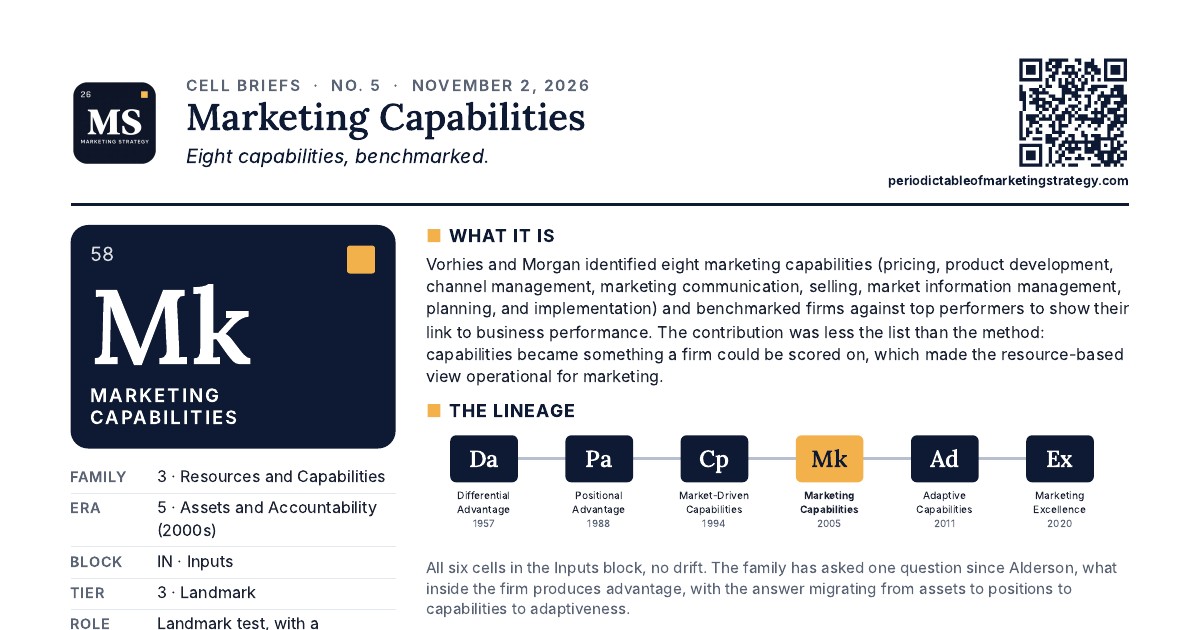
What It Is
Vorhies and Morgan identified eight marketing capabilities (pricing, product development, channel management, marketing communication, selling, market information management, planning, and implementation) and benchmarked firms against top performers to show their link to business performance. The contribution was less the list than the method: capabilities became something a firm could be scored on, which made the resource-based view operational for marketing.
The Lineage
- Da
Differential Advantage
1957
- Pa
Positional Advantage
1988
- Cp
Market-Driven Capabilities
1994
- Mk
Marketing Capabilities
2005
- Ad
Adaptive Capabilities
2011
- Ex
Marketing Excellence
2020
All six cells in the Inputs block, no drift. The family has asked one question since Alderson, what inside the firm produces advantage, with the answer migrating from assets to positions to capabilities to adaptiveness.
Where It Travels
One curated link out, to Strategy-Structure Fit (organization configurations are assessed against capabilities), and 17 deep-dive mentions in nine families. Its most active export market is international marketing: born globals, multinationality and capabilities, export strategy implementation, and international marketing capabilities all name it.
What It Rests On
One curated link in, from the Marketing Mix (Mx): the eight capabilities are the mix executed. The anchor cites 17 other anchor works, the most of any of the ten with Market-Based Assets, including Day and Wensley (1988), Day (1994), Hunt and Morgan (1995), both market orientation anchors, March (1991), and the ACSI paper (1996). The list was assembled from four families' landmarks.
Descendants You Would Not Guess
29 anchor works in 11 families cite it; seven Core cells hold one: Adaptive Capabilities (Day, 2011), Performance Outcomes (Katsikeas et al., 2016), Marketing Excellence (Homburg, Theel, and Hohenberg, 2020), CSR and Market Value, Manager-Customer Gap, Strategy-Structure Fit, and Market-Focused Sustainability. Less expected: CMO Presence (Nath and Mahajan, 2008), the Marketing-Sales interface (Hughes, Le Bon, and Malshe, 2012), and Resource-Based Theory in Marketing (Kozlenkova, Samaha, and Palmatier, 2014).
Three Things The Cell Does Not Show
- The second-longest wait among the ten. Forty-eight years passed between Alderson's differential advantage (1957) and a measured set of marketing capabilities (2005). The family defined early and measured late; only Advertising Elasticity waited longer.
- A synthesis disguised as a scale. Its reference list draws on orientation, satisfaction, learning, and advantage research before it measures anything. The capability list is where four families' landmarks were first scored together.
- The deep dive doubles the anchor. Sub-table cell D3-11 adds Morgan, Vorhies, and Mason (2009), the paper that tied capabilities back to market orientation and performance. The sub-lineage's open position is Marketing capabilities built on AI (D3-O3).
Anchor Works
Cite as: Hult, G. Tomas M. (2026), “Marketing Capabilities,” Cell Briefs No. 5, The Periodic Table of Marketing Strategy.
Link counts and citing works are from the site's analysis dataset (Version 1.0). Placements, anchors, and tiers are editorial judgments; verify against the original works.
Copyright © G. Tomas M. Hult 2026