
What It Is
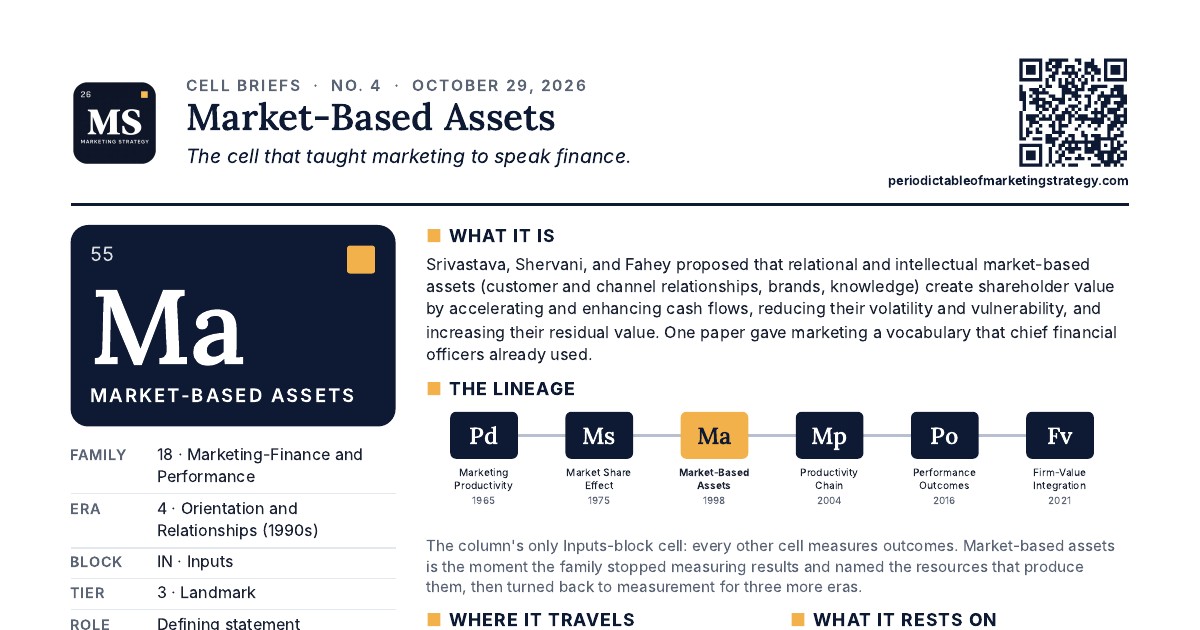
Srivastava, Shervani, and Fahey proposed that relational and intellectual market-based assets (customer and channel relationships, brands, knowledge) create shareholder value by accelerating and enhancing cash flows, reducing their volatility and vulnerability, and increasing their residual value. One paper gave marketing a vocabulary that chief financial officers already used.
The Lineage
- Pd
Marketing Productivity
1965
- Ms
Market Share Effect
1975
- Ma
Market-Based Assets
1998
- Mp
Productivity Chain
2004
- Po
Performance Outcomes
2016
- Fv
Firm-Value Integration
2021
The column's only Inputs-block cell: every other cell measures outcomes. Market-based assets is the moment the family stopped measuring results and named the resources that produce them, then turned back to measurement for three more eras.
Where It Travels
Four curated links out: Satisfaction and Firm Value, Customer Equity and CLV, Brand Portfolio, and CSR and Market Value. Each of those families obtained its "and firm value" cell by borrowing this logic. Eighteen deep-dive mentions in nine families add innovation and stock returns, financial brand valuation, customer-based valuation, and supply chain disruption costs.
What It Rests On
Three curated links in: Brand Equity (the intellectual asset it starts from), Commitment-Trust (the relational asset), and Positional Advantage with Market-Driven Capabilities (the resource view applied outside the firm). Its reference list reads like the 1990s Core Table: Kohli and Jaworski, Narver and Slater, Day 1994, Hunt and Morgan 1995, Keller 1993, Anderson, Fornell, and Lehmann 1994.
Descendants You Would Not Guess
44 anchor works in 13 families cite it; 16 Core cells hold one. Expected: Satisfaction and Firm Value, Customer Equity (Gupta, Lehmann, and Stuart, 2004; Rust, Lemon, and Zeithaml, 2004), Performance Outcomes. Less expected: Radical Innovation (Chandy and Tellis, 2000), CMO and Marketing Power (Feng, Morgan, and Rego, 2015; Germann, Ebbes, and Grewal, 2015), Brand Activism (Vredenburg et al., 2020), myopic management (Mizik and Jacobson, 2003), and subscription valuation (McCarthy, Fader, and Hardie, 2017).
Three Things The Cell Does Not Show
- The paper had a prequel. In the deep dive, the sub-lineage begins with Day and Fahey (1988), Valuing Market Strategies, written by one of the same authors ten years earlier. The framework was a decade in the making before it was named.
- It is the exchange rate of the table. Satisfaction, customer equity, brand portfolio, and CSR each reach firm value through this cell's cash-flow logic. No other cell is the curated source for four separate families' valuation cells.
- Its block is a one-off. The only Inputs cell in an outcomes column. The family drifted into resources for one era and back out, which is why the Productivity Chain (2004) reads as a reply to this paper rather than a continuation of it.
Anchor Works
Cite as: Hult, G. Tomas M. (2026), “Market-Based Assets,” Cell Briefs No. 4, The Periodic Table of Marketing Strategy.
Link counts and citing works are from the site's analysis dataset (Version 1.0). Placements, anchors, and tiers are editorial judgments; verify against the original works.
Copyright © G. Tomas M. Hult 2026