
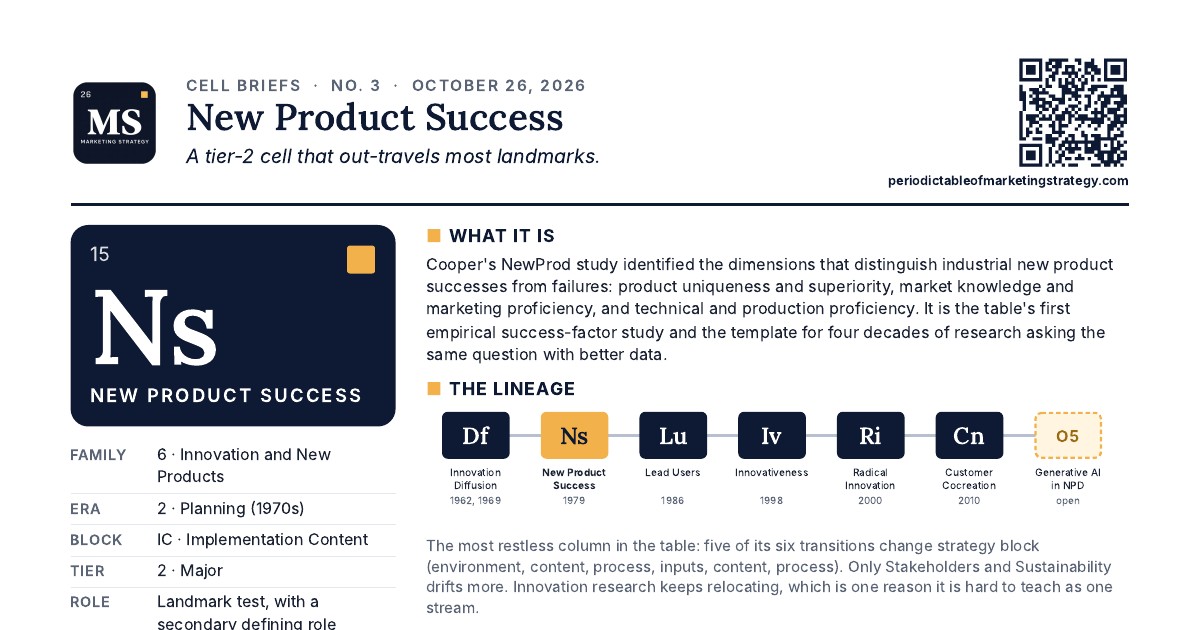
What It Is
Cooper's NewProd study identified the dimensions that distinguish industrial new product successes from failures: product uniqueness and superiority, market knowledge and marketing proficiency, and technical and production proficiency. It is the table's first empirical success-factor study and the template for four decades of research asking the same question with better data.
The Lineage
- Df
Innovation Diffusion
1962, 1969
- Ns
New Product Success
1979
- Lu
Lead Users
1986
- Iv
Innovativeness
1998
- Ri
Radical Innovation
2000
- Cn
Customer Cocreation
2010
- O5
Generative AI in NPD
open
The most restless column in the table: five of its six transitions change strategy block (environment, content, process, inputs, content, process). Only Stakeholders and Sustainability drifts more. Innovation research keeps relocating, which is one reason it is hard to teach as one stream.
Where It Travels
Two curated links out, Proactive Market Orientation (latent needs drive new product success) and Exploration-Exploitation (judged by new product outcomes), plus 21 deep-dive mentions in 11 families, eight of them in Learning and Knowledge. It travels as a vocabulary: "new product success" is the outcome variable of half the learning stream.
What It Rests On
One curated link in, from the Marketing Concept (Mc): market knowledge and marketing proficiency are the concept applied to development. Cooper (1979) cites no other anchor work on the table, the only cell among the ten that started its lineage from outside it.
Descendants You Would Not Guess
Only five anchor works cite it, in three families: the diffusion research agenda (Gatignon and Robertson, 1985), both Pioneer Advantage reassessments (Kerin, Varadarajan, and Peterson, 1992; Golder and Tellis, 1993), new service development (Johne and Storey, 1998), and the success-factor meta-analysis (Henard and Szymanski, 2001). Few citations, long shadow: its sub-lineage asks Cooper's question five times, in 1987, 1994, 2001, and 2012.
Three Things The Cell Does Not Show
- Named often, cited rarely. 23 links name it, third in the table; five anchors cite it. Its influence runs through vocabulary and a sub-lineage of replications (Winners and Losers, Performance Determinants, Why New Products Succeed, Updated Success Factors) rather than through citation.
- A tier-2 cell among landmarks. Every other cell in the ten is tier 3. New Product Success earns its traffic from being the first answer to a question that never closed.
- Its frontier is generative. Open position O5, Generative AI in new product development, extends Lead Users, Radical Innovation, and Cocreation; the sub-lineage's own open position (D6-O2) asks the same of success factors.
Anchor Works
Cite as: Hult, G. Tomas M. (2026), “New Product Success,” Cell Briefs No. 3, The Periodic Table of Marketing Strategy.
Link counts and citing works are from the site's analysis dataset (Version 1.0). Placements, anchors, and tiers are editorial judgments; verify against the original works.
Copyright © G. Tomas M. Hult 2026