
What It Is
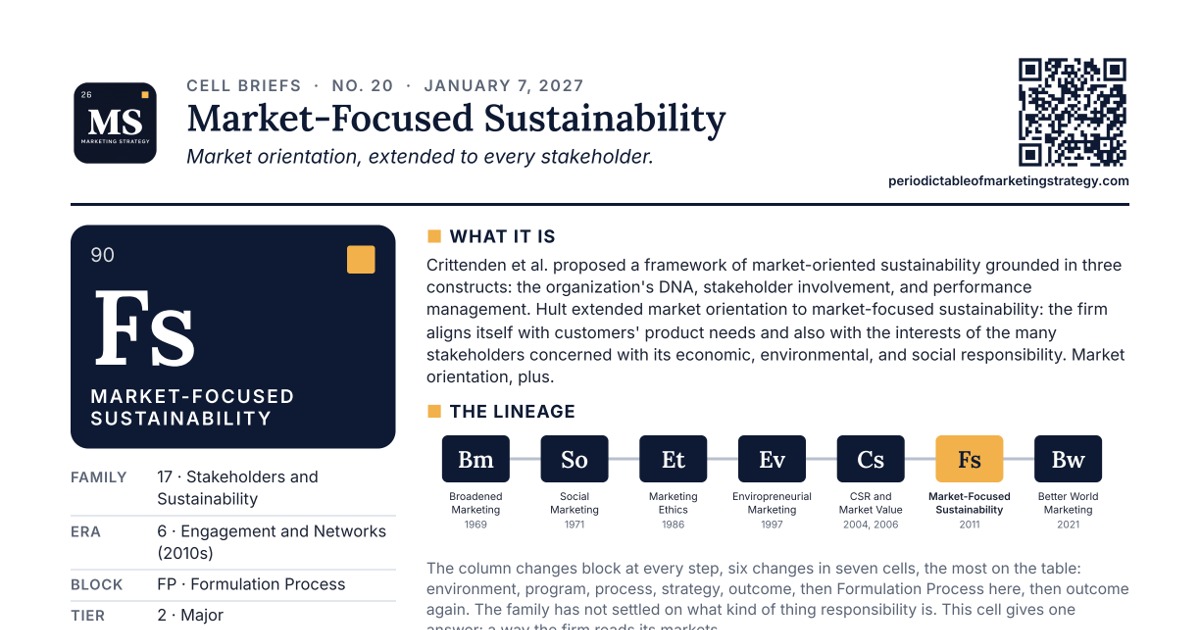
Crittenden et al. proposed a framework of market-oriented sustainability grounded in three constructs: the organization's DNA, stakeholder involvement, and performance management. Hult extended market orientation to market-focused sustainability: the firm aligns itself with customers' product needs and also with the interests of the many stakeholders concerned with its economic, environmental, and social responsibility. Market orientation, plus.
The Lineage
- Bm
Broadened Marketing
1969
- So
Social Marketing
1971
- Et
Marketing Ethics
1986
- Ev
Enviropreneurial Marketing
1997
- Cs
CSR and Market Value
2004, 2006
- Fs
Market-Focused Sustainability
2011
- Bw
Better World Marketing
2021
The column changes block at every step, six changes in seven cells, the most on the table: environment, program, process, strategy, outcome, then Formulation Process here, then outcome again. The family has not settled on what kind of thing responsibility is. This cell gives one answer: a way the firm reads its markets.
Where It Travels
No curated links out. Two deep-dive mentions, both in the supply chain deep dive (reverse logistics and sustainable supply chains), match on the family's words more than on this construct. On the Core Table the cell receives and does not yet send; the column continues to Better World Marketing (2021).
What It Rests On
One curated link in, from Market Orientation (Mo). Crittenden et al. cite 15 other anchor works: eight sit in the market orientation deep dive and three in their own family. Hult cites eight, among them Ferrell et al. (2010) on stakeholder orientation and Varadarajan (2010) on the domain of strategy. By ancestry this is a market orientation cell placed in the sustainability column.
Descendants You Would Not Guess
Two anchor works cite the cell, both in resources and capabilities: Capabilities Framework and Dispersion (Morgan, 2012) and Adaptive Capabilities (Barrales-Molina, Martínez- López, and Gázquez-Abad, 2014). In the deep dive the cell also holds the map of sustainability research by Chabowski, Mena, and Gonzalez-Padron (2011). It follows Strategy and Society (Porter and Kramer, 2006) and precedes Market-Driving Sustainable Marketing (Sheth and Parvatiyar, 2021).
Three Things The Cell Does Not Show
- One journal issue. Both anchors, and the deep dive's third, appeared in the same 2011 issue of the Journal of the Academy of Marketing Science (volume 39, number 1). The cell records a moment when one journal put the question to the field.
- The author of this brief wrote one of the anchors. Placements and tiers are editorial judgments throughout the table, and here the editor is also an author. The citation data are the outside check: the anchors sit at the 48th and 43rd percentiles of 2010s works by citations per year, and the tier is Major, not Landmark.
- Young cells have few heirs. Two citing works is a low count (82nd of the 98 cells). Part of the reason is age: about one in six anchor works on the table was published after 2011, so few could cite it.
Anchor Works
Cite as: Hult, G. Tomas M. (2027), “Market-Focused Sustainability,” Cell Briefs No. 20, The Periodic Table of Marketing Strategy.
Link counts and citing works are from the site's analysis dataset (Version 1.0). Placements, anchors, and tiers are editorial judgments; verify against the original works.
Copyright © G. Tomas M. Hult 2026