
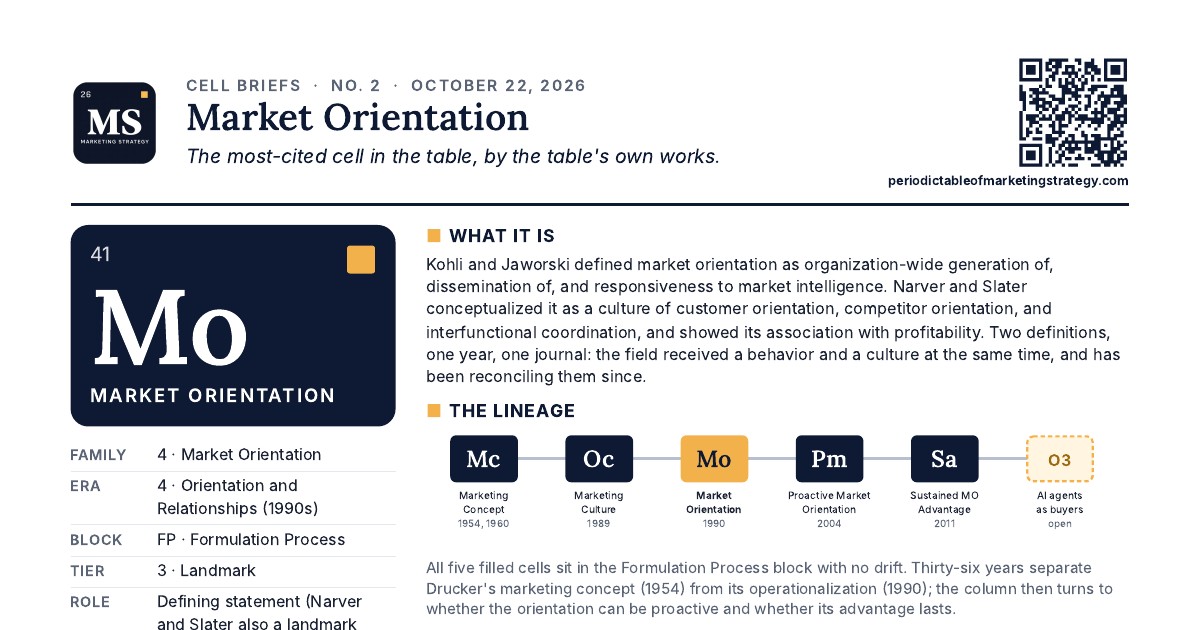
What It Is
Kohli and Jaworski defined market orientation as organization-wide generation of, dissemination of, and responsiveness to market intelligence. Narver and Slater conceptualized it as a culture of customer orientation, competitor orientation, and interfunctional coordination, and showed its association with profitability. Two definitions, one year, one journal: the field received a behavior and a culture at the same time, and has been reconciling them since.
The Lineage
- Mc
Marketing Concept
1954, 1960
- Oc
Marketing Culture
1989
- Mo
Market Orientation
1990
- Pm
Proactive Market Orientation
2004
- Sa
Sustained MO Advantage
2011
- O3
AI agents as buyers
open
All five filled cells sit in the Formulation Process block with no drift. Thirty-six years separate Drucker's marketing concept (1954) from its operationalization (1990); the column then turns to whether the orientation can be proactive and whether its advantage lasts.
Where It Travels
Ten curated Core Table links, the most of any cell: Resource-Advantage Theory, Market-Driven Capabilities, Learning Orientation, Innovativeness, Role of Marketing, Market Driving, Exploration-Exploitation, Supply Chain Orientation, Market-Focused Sustainability, and Marketing Excellence. Twenty more deep-dive cells in nine families name it.
What It Rests On
No curated link in; the cell is a source, not a destination. Its reference lists tell the story instead: both anchors cite Day and Wensley (1988, Positional Advantage) and Deshpandé and Webster (1989, Marketing Culture), and Narver and Slater cite Kohli and Jaworski. Advantage and culture are its parents.
Descendants You Would Not Guess
106 anchor works in 15 families cite the two 1990 papers, and 30 of the 98 Core cells hold one of them: Resource-Advantage Theory (Hunt and Morgan, 1995), Market-Based Assets (Srivastava, Shervani, and Fahey, 1998), Service-Dominant Logic (Vargo and Lusch, 2004), Satisfaction and Firm Value (Anderson, Fornell, and Mazvancheryl, 2004), Emerging Market Strategy (Sheth, 2011), Marketing Agility (Kalaignanam et al., 2021), and Upper Echelons in Marketing (Whitler et al., 2021).
Three Things The Cell Does Not Show
- Two definitions, one issue. Both anchors appeared in the Journal of Marketing in 1990 and share the same two parents. The deep dive devotes a cell to reconciling them (Perspectives Synthesis, 2001) and another to comparing their three scales (2005). The argument is part of the construct.
- It reaches almost a third of the Core Table. 30 of 98 Core cells hold an anchor that cites market orientation; Market-Driven Capabilities, the next most-cited cell, is cited by 91 anchor works to this cell's 106.
- Its frontier is the buyer, not the firm. Open position O3 asks what intelligence generation, dissemination, and responsiveness mean when AI agents make or mediate purchases for customers, extending this cell and Proactive Market Orientation.
Anchor Works
Cite as: Hult, G. Tomas M. (2026), “Market Orientation,” Cell Briefs No. 2, The Periodic Table of Marketing Strategy.
Link counts and citing works are from the site's analysis dataset (Version 1.0). Placements, anchors, and tiers are editorial judgments; verify against the original works.
Copyright © G. Tomas M. Hult 2026