
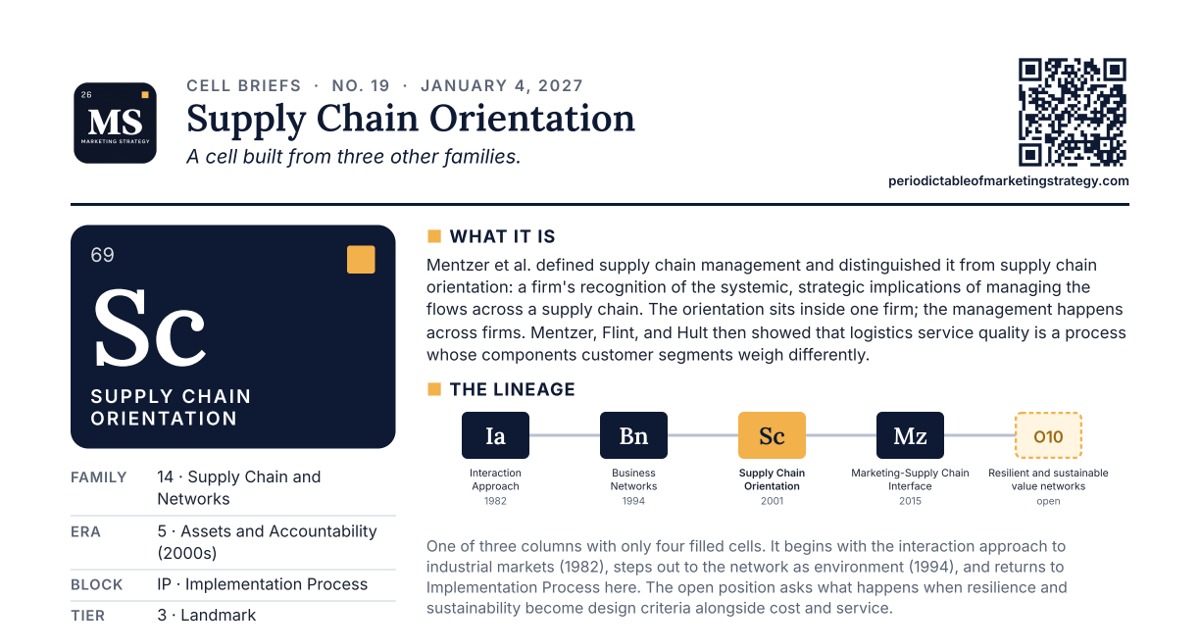
What It Is
Mentzer et al. defined supply chain management and distinguished it from supply chain orientation: a firm's recognition of the systemic, strategic implications of managing the flows across a supply chain. The orientation sits inside one firm; the management happens across firms. Mentzer, Flint, and Hult then showed that logistics service quality is a process whose components customer segments weigh differently.
The Lineage
- Ia
Interaction Approach
1982
- Bn
Business Networks
1994
- Sc
Supply Chain Orientation
2001
- Mz
Marketing-Supply Chain Interface
2015
- O10
Resilient and sustainable value networks
open
One of three columns with only four filled cells. It begins with the interaction approach to industrial markets (1982), steps out to the network as environment (1994), and returns to Implementation Process here. The open position asks what happens when resilience and sustainability become design criteria alongside cost and service.
Where It Travels
No curated links out. Two deep-dive mentions match on the phrase supply chain: dual-channel design in the channels deep dive and cross-border relationship governance in global marketing. On the Core Table the cell receives from three columns and passes what it gathers down its own, to the Marketing-Supply Chain Interface (2015).
What It Rests On
Three curated links in, the most of any cell (six cells share that count): Market Orientation (Mo), the model for an organizational orientation; Service Quality (Sq), the model for the logistics scale; and Relational Governance (Rg), the logic among chain members. The logistics service quality paper cites 10 other anchor works, eight of them from the services deep dive.
Descendants You Would Not Guess
Six anchor works cite the logistics service quality paper, among them Customer-Relating Capability (Day, 2003), Knowledge Development in Supply Chains (Hult et al., 2006), Order Fulfillment and Loyalty (Davis-Sramek, Mentzer, and Stank, 2008), and Electronic Logistics Service Quality (Rao et al., 2011). The definition paper is cited in the Marketing- Supply Chain Interface (Esper et al., 2010; Kozlenkova et al., 2015) and in two operations cells (Cao and Zhang, 2011; Hendricks and Singhal, 2003).
Three Things The Cell Does Not Show
- Two anchors, two disciplines. The definition appeared in the Journal of Business Logistics and the scale in the Journal of Marketing, in the same year and with the same first author. Among the supply chain deep dive's anchors, only Porter's (1985) book is cited more often.
- Named for the orientation, defined with the management. The cell carries the name of the philosophy inside one firm, while its defining paper is titled for the coordination across firms. The deep dive adds Hult, Ketchen, and Arrfelt (2007) on strategic supply chain management and performance.
- The sub-lineage is filled through the 2020s. It runs from Porter's value chain (1985) and product-supply chain fit (Cooper, Lambert, and Pagh, 1997; Fisher, 1997) through this cell to supply chain management redefined (Min, Zacharia, and Smith, 2019) and supply chains in crisis (Ketchen and Craighead, 2020).
Anchor Works
Cite as: Hult, G. Tomas M. (2027), “Supply Chain Orientation,” Cell Briefs No. 19, The Periodic Table of Marketing Strategy.
Link counts and citing works are from the site's analysis dataset (Version 1.0). Placements, anchors, and tiers are editorial judgments; verify against the original works.
Copyright © G. Tomas M. Hult 2026