
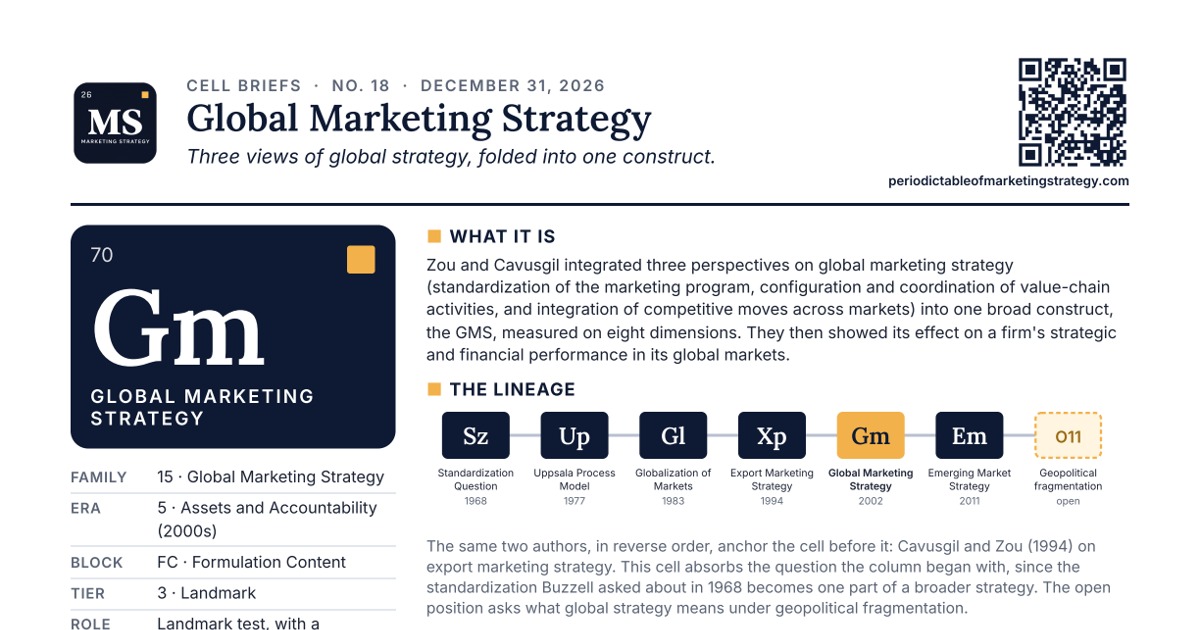
What It Is
Zou and Cavusgil integrated three perspectives on global marketing strategy (standardization of the marketing program, configuration and coordination of value-chain activities, and integration of competitive moves across markets) into one broad construct, the GMS, measured on eight dimensions. They then showed its effect on a firm's strategic and financial performance in its global markets.
The Lineage
- Sz
Standardization Question
1968
- Up
Uppsala Process Model
1977
- Gl
Globalization of Markets
1983
- Xp
Export Marketing Strategy
1994
- Gm
Global Marketing Strategy
2002
- Em
Emerging Market Strategy
2011
- O11
Geopolitical fragmentation
open
The same two authors, in reverse order, anchor the cell before it: Cavusgil and Zou (1994) on export marketing strategy. This cell absorbs the question the column began with, since the standardization Buzzell asked about in 1968 becomes one part of a broader strategy. The open position asks what global strategy means under geopolitical fragmentation.
Where It Travels
No curated links out. Six deep-dive mentions match on the words international, export, cross-national, and global: two cells on international marketing capabilities, export market orientation, cross-national studies of market orientation and of satisfaction, and learning-based purchasing. They trace the family's vocabulary more than this construct.
What It Rests On
Two curated links in: Marketing Mix (Mx), whose program elements it standardizes, and Competitive Positioning (Ps), the source of configuration and coordination. From its own column the anchor cites Cavusgil and Zou (1994) and Levitt (1983); from outside its family, Day (1994), Li and Calantone (1998), and Szymanski, Bharadwaj, and Varadarajan (1993).
Descendants You Would Not Guess
Eight anchor works cite it, seven in the global marketing deep dive and none on the Core Table. Among them: Export Venture Performance (Morgan, Kaleka, and Katsikeas, 2004), Fifty Years of Standardization Research (Schmid and Kotulla, 2011), Global and Local Brands (Özsomer, 2012; Steenkamp, 2014), and Export Strategy Implementation (Morgan, Katsikeas, and Vorhies, 2012). The one outsider is Share Effects Reexamined (Edeling and Himme, 2018).
Three Things The Cell Does Not Show
- A cell that gathers more than it sends. Two curated links in, none out, and seven of eight citing works inside its own deep dive. Global marketing strategy imports constructs from the rest of the table and is cited mostly within its own family.
- It closes a debate more than it opens one. The deep-dive sub-lineage runs from global strategy configuration (Hamel and Prahalad, 1985; Porter, 1986) and drivers (Yip, 1989; Zou and Cavusgil, 1996) to this cell, and then to field-level reflections (Cavusgil and Cavusgil, 2012; Samiee and Chabowski, 2012), not to a new construct.
- Landmark by judgment. The anchor sits at the 48th percentile of 2000s works by citations per year. Its tier reflects its place as the integrating statement of its family, which the citation rate alone would not show.
Anchor Works
Cite as: Hult, G. Tomas M. (2026), “Global Marketing Strategy,” Cell Briefs No. 18, The Periodic Table of Marketing Strategy.
Link counts and citing works are from the site's analysis dataset (Version 1.0). Placements, anchors, and tiers are editorial judgments; verify against the original works.
Copyright © G. Tomas M. Hult 2026