
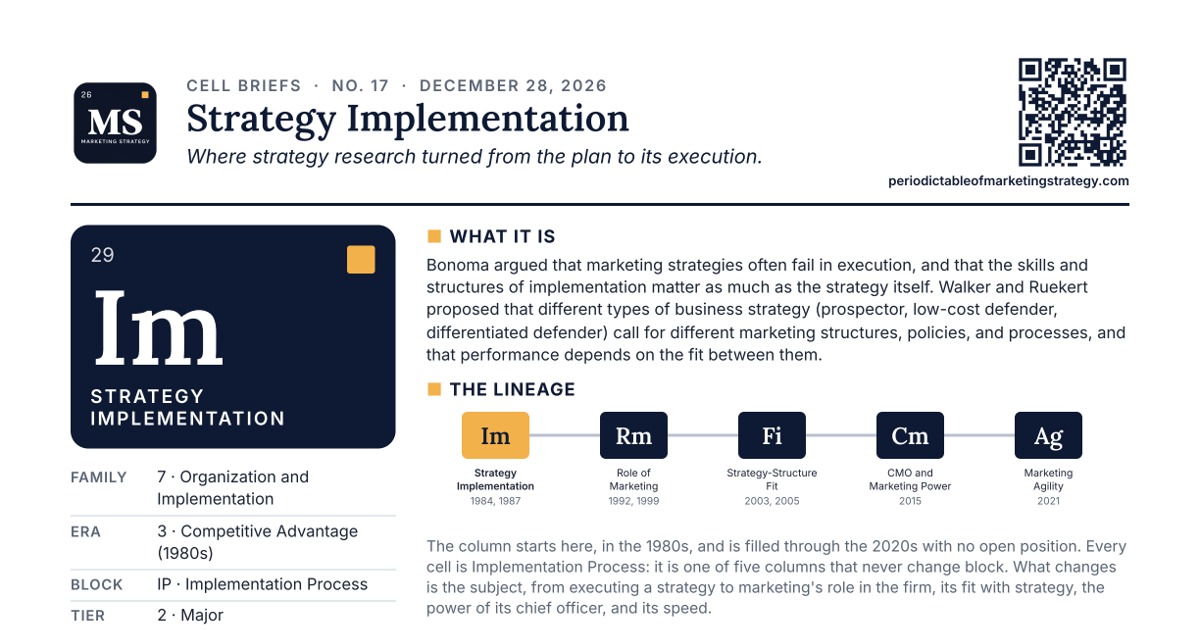
What It Is
Bonoma argued that marketing strategies often fail in execution, and that the skills and structures of implementation matter as much as the strategy itself. Walker and Ruekert proposed that different types of business strategy (prospector, low-cost defender, differentiated defender) call for different marketing structures, policies, and processes, and that performance depends on the fit between them.
The Lineage
- Im
Strategy Implementation
1984, 1987
- Rm
Role of Marketing
1992, 1999
- Fi
Strategy-Structure Fit
2003, 2005
- Cm
CMO and Marketing Power
2015
- Ag
Marketing Agility
2021
The column starts here, in the 1980s, and is filled through the 2020s with no open position. Every cell is Implementation Process: it is one of five columns that never change block. What changes is the subject, from executing a strategy to marketing's role in the firm, its fit with strategy, the power of its chief officer, and its speed.
Where It Travels
Three curated links out: Strategy Making and Strategic Marketing Types in the strategy column, and Marketing Doctrine in the learning column. Four deep-dive mentions match on the word implementation. Two come later (strategy creativity and implementation, export strategy implementation); two sit in 1970s cells that precede this one, where the direction of influence is doubtful.
What It Rests On
One curated link in, from Competitive Positioning (Ps): implementation research takes competitive strategy as given and asks how marketing executes it. Walker and Ruekert cite six other anchor works, among them Anderson (1982), Miles and Snow (1978), and Ruekert, Walker, and Roering (1985). Bonoma's article has no record in the citation data.
Descendants You Would Not Guess
Thirty-one anchor works in nine families cite Walker and Ruekert, the most for any Major cell on the table. Six Core cells hold one: Marketing Culture (Deshpandé and Webster, 1989), Strategic Marketing Types (Slater and Olson, 2001), Strategy-Structure Fit (Olson, Slater, and Hult, 2005; Vorhies and Morgan, 2003), Proactive Market Orientation (Narver, Slater, and MacLachlan, 2004), Performance Outcomes (Katsikeas et al., 2016), and Marketing Excellence (Homburg, Theel, and Hohenberg, 2020).
Three Things The Cell Does Not Show
- Half the cell is invisible to the citation data. Bonoma (1984) is one of seven Harvard Business Review anchors on the Core Table and could not be matched to a citation record. Every citing work counted here cites Walker and Ruekert.
- A Major cell cited like a Landmark. Its 31 citing works place it in a tie for 15th of the 98 cells; the median Landmark cell has 16. Tiers are editorial judgments, and this is a cell where the citation data and the tier point in different directions.
- Implementation keeps its own sub-lineage. In the deep dive it continues through implementing marketing strategies (Noble and Mokwa, 1999; Piercy, 1998), implementation approaches (Sashittal and Jassawalla, 2001; Thorpe and Morgan, 2007), and customer experience management (Homburg, Jozić, and Kuehnl, 2017) to an open position: implementation through automation (D7-O3).
Anchor Works
Cite as: Hult, G. Tomas M. (2026), “Strategy Implementation,” Cell Briefs No. 17, The Periodic Table of Marketing Strategy.
Link counts and citing works are from the site's analysis dataset (Version 1.0). Placements, anchors, and tiers are editorial judgments; verify against the original works.
Copyright © G. Tomas M. Hult 2026