
What It Is
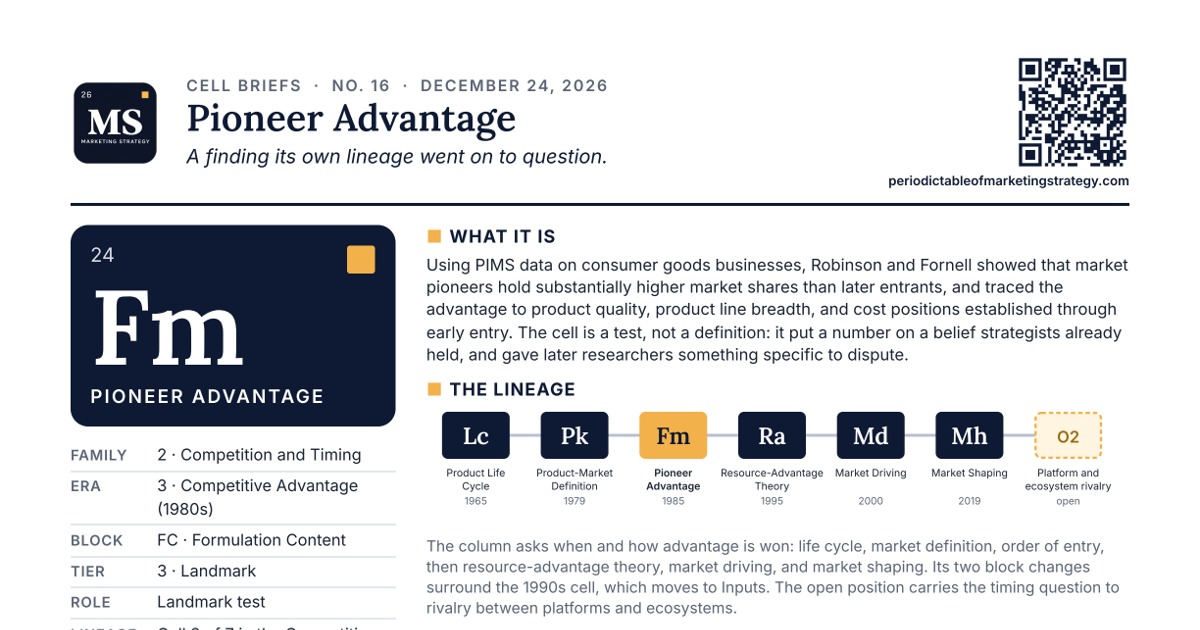
Using PIMS data on consumer goods businesses, Robinson and Fornell showed that market pioneers hold substantially higher market shares than later entrants, and traced the advantage to product quality, product line breadth, and cost positions established through early entry. The cell is a test, not a definition: it put a number on a belief strategists already held, and gave later researchers something specific to dispute.
The Lineage
- Lc
Product Life Cycle
1965
- Pk
Product-Market Definition
1979
- Fm
Pioneer Advantage
1985
- Ra
Resource-Advantage Theory
1995
- Md
Market Driving
2000
- Mh
Market Shaping
2019
- O2
Platform and ecosystem rivalry
open
The column asks when and how advantage is won: life cycle, market definition, order of entry, then resource-advantage theory, market driving, and market shaping. Its two block changes surround the 1990s cell, which moves to Inputs. The open position carries the timing question to rivalry between platforms and ecosystems.
Where It Travels
One curated link out, to Radical Innovation: the incumbent's curse is the pioneer question asked of radical innovation. Seven deep-dive mentions are recorded, in market orientation, learning, capabilities, and organization, but each matches on the word competitor, a construct of the family and not of this cell.
What It Rests On
One curated link in, from Market Share Effect (Ms): pioneer advantage was established with PIMS share data and the share-profitability logic. The anchor cites two other anchor works, Day (1981) on the product life cycle and the companion study of pioneering brands by Urban et al. (1986).
Descendants You Would Not Guess
Eleven anchor works cite it, seven in its own deep dive and none on the Core Table. The four outside: Elasticity Generalizations and Overadvertising (Tellis, 1988), Financial Brand Valuation (Simon and Sullivan, 1993), Share-Profitability Analysis (Szymanski, Bharadwaj, and Varadarajan, 1993), and Sustainable Advantage in Services (Bharadwaj, Varadarajan, and Fahy, 1993). Each treats order of entry as a variable to control for or an asset to count.
Three Things The Cell Does Not Show
- The lineage argues with it. In the deep dive the next cell is Pioneer Advantage Reassessed (Golder and Tellis, 1993; Kerin, Varadarajan, and Peterson, 1992; Szymanski, Troy, and Bharadwaj, 1995), then Sustainable Pioneering Advantage (Boulding and Christen, 2003). The block changes from Formulation Content to Outcomes: a strategic choice became a result to be explained.
- Landmark by judgment, not by citation rate. The anchor sits at the 47th percentile of 1980s works by citations per year, and 14th of the 16 Core works of its decade that have a citation record. The tier reflects what the test settled and the argument it started.
- No cell after 2003. The order-of-entry sub-lineage has no cell in the 2010s. Its open position asks about entry timing when AI compresses development and imitation (D2-O3); the Core column asks about platforms. Both are the same question about who moves first.
Anchor Works
Cite as: Hult, G. Tomas M. (2026), “Pioneer Advantage,” Cell Briefs No. 16, The Periodic Table of Marketing Strategy.
Link counts and citing works are from the site's analysis dataset (Version 1.0). Placements, anchors, and tiers are editorial judgments; verify against the original works.
Copyright © G. Tomas M. Hult 2026