
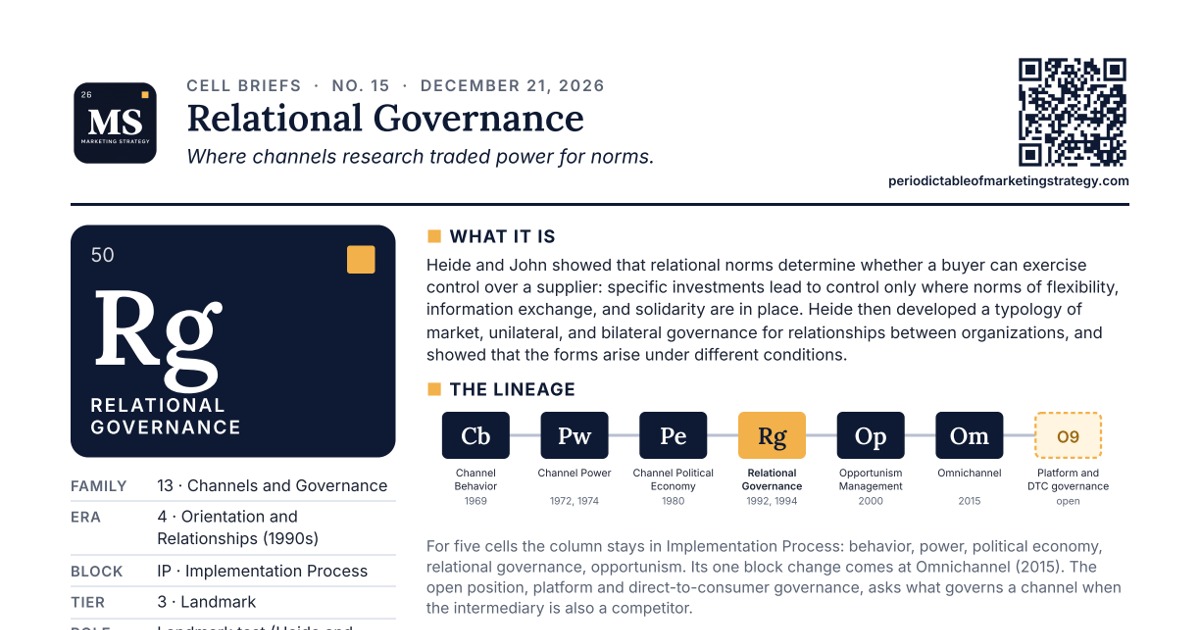
What It Is
Heide and John showed that relational norms determine whether a buyer can exercise control over a supplier: specific investments lead to control only where norms of flexibility, information exchange, and solidarity are in place. Heide then developed a typology of market, unilateral, and bilateral governance for relationships between organizations, and showed that the forms arise under different conditions.
The Lineage
- Cb
Channel Behavior
1969
- Pw
Channel Power
1972, 1974
- Pe
Channel Political Economy
1980
- Rg
Relational Governance
1992, 1994
- Op
Opportunism Management
2000
- Om
Omnichannel
2015
- O9
Platform and DTC governance
open
For five cells the column stays in Implementation Process: behavior, power, political economy, relational governance, opportunism. Its one block change comes at Omnichannel (2015). The open position, platform and direct-to-consumer governance, asks what governs a channel when the intermediary is also a competitor.
Where It Travels
Two curated links out, both to the supply chain column: Supply Chain Orientation and the Marketing-Supply Chain Interface. Three deep-dive mentions, all in global marketing strategy, follow transaction cost and relational norms across borders: entry mode as transaction cost, international channel governance, and cross-border relationship governance.
What It Rests On
One curated link in, from Buyer-Seller Relationships (Br) in the relationships column, the source of its relational exchange norms. Heide (1994) cites 10 anchor works, eight of them from the channels deep dive, from Stern (1969) to Anderson and Narus (1990) and its companion anchor. Heide and John (1992) cite three.
Descendants You Would Not Guess
Thirty-five anchor works in 11 families cite the cell, 13 in the channels deep dive and seven in global marketing. Elsewhere: Commitment-Trust (Morgan and Hunt, 1994), Business Networks (Anderson, Håkansson, and Johanson, 1994), Service-Dominant Logic (Vargo and Lusch, 2004), Privacy as Implied Social Contract (Milne and Gordon, 1993), Complaint Handling Justice (Tax, Brown, and Chandrashekaran, 1998), and Customer- Relating Capability (Day, 2003).
Three Things The Cell Does Not Show
- Two columns that trade. Its curated source is in the relationships column. Commitment-Trust, in that column, takes its curated source from channels and cites Heide and John (1992). In the 1990s the two columns worked on one problem under two names, governance and relationship.
- It exports to two places only. All five of its documented links go to supply chain or global marketing. In the link data, governance theory traveled along the physical channel and across borders and nowhere else, although its citing works come from 11 families.
- Contracts return in the deep dive. The governance sub-lineage runs from political economy (Arndt, 1983; Stern and Reve, 1980) through this cell to opportunism (Wathne and Heide, 2000) and to contracts and extracontractual incentives (Kashyap, Antia, and Frazier, 2012). Its open position: governance by terms of service and algorithms (D13-O4).
Anchor Works
Cite as: Hult, G. Tomas M. (2026), “Relational Governance,” Cell Briefs No. 15, The Periodic Table of Marketing Strategy.
Link counts and citing works are from the site's analysis dataset (Version 1.0). Placements, anchors, and tiers are editorial judgments; verify against the original works.
Copyright © G. Tomas M. Hult 2026