
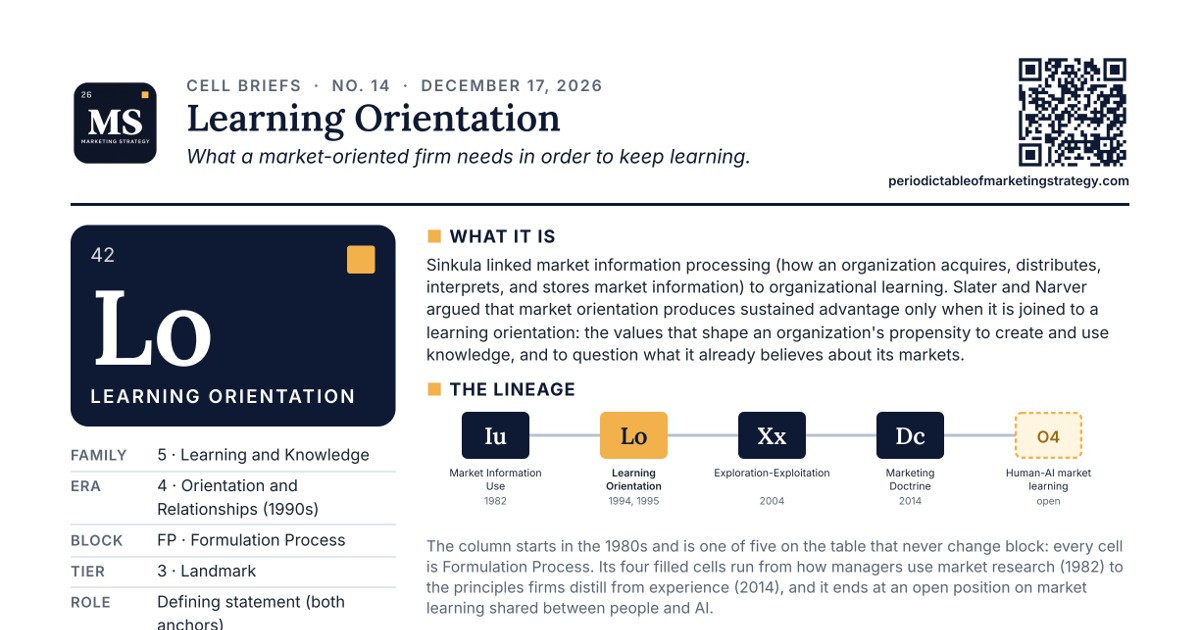
What It Is
Sinkula linked market information processing (how an organization acquires, distributes, interprets, and stores market information) to organizational learning. Slater and Narver argued that market orientation produces sustained advantage only when it is joined to a learning orientation: the values that shape an organization's propensity to create and use knowledge, and to question what it already believes about its markets.
The Lineage
- Iu
Market Information Use
1982
- Lo
Learning Orientation
1994, 1995
- Xx
Exploration-Exploitation
2004
- Dc
Marketing Doctrine
2014
- O4
Human-AI market learning
open
The column starts in the 1980s and is one of five on the table that never change block: every cell is Formulation Process. Its four filled cells run from how managers use market research (1982) to the principles firms distill from experience (2014), and it ends at an open position on market learning shared between people and AI.
Where It Travels
Three curated links out, each to a different family: Innovativeness, Adaptive Capabilities, and Marketing Agility. Of seven deep-dive mentions, four are in the supply chain deep dive (learning-based purchasing, supply chain orientation, knowledge development in supply chains, the marketing-supply chain interface), where organizational learning was applied to purchasing and logistics.
What It Rests On
One curated link in, from Market Orientation (Mo): learning orientation is the complement market orientation needs. Slater and Narver cite 20 other anchor works, among them both market orientation anchors, Day (1994), Day and Wensley (1988), Fiol and Lyles (1985), March (1991), and Sinkula (1994). Sinkula cites four.
Descendants You Would Not Guess
Fifty-three anchor works in 13 families cite the cell, and 12 Core cells hold one. Among them: Market-Driven Capabilities (Day, 1994), Customer Value (Woodruff, 1997), Innovativeness (Han, Kim, and Srivastava, 1998; Hurley and Hult, 1998), Service- Dominant Logic (Vargo and Lusch, 2004), Marketing Capabilities (Vorhies and Morgan, 2005), Market Shaping (Nenonen, Storbacka, and Windahl, 2019), and Marketing Agility (Kalaignanam et al., 2021).
Three Things The Cell Does Not Show
- Mid-decade by citation rate, fourth by anchor citations. The two anchors sit at the 58th and 69th percentiles of 1990s works by citations per year, yet only Market Orientation, Market-Driven Capabilities, and Role of Marketing are cited by more anchor works. Its weight is in how often other cells build on it.
- A hinge between orientation and capability. Of the 53 citing works, 11 appear in the learning deep dive, 11 in market orientation, and nine in resources and capabilities. The cell sits where the question changed from what a firm attends to, to what it is able to do.
- The sub-lineage stops early. In the deep dive, organizational learning runs from Fiol and Lyles (1985) through this cell to the schools of thought reviewed by Bell, Whitwell, and Lukas (2002). No cell follows in the 2010s, and its open position is the one the Core column ends on: human-AI market learning (D5-O2).
Anchor Works
Cite as: Hult, G. Tomas M. (2026), “Learning Orientation,” Cell Briefs No. 14, The Periodic Table of Marketing Strategy.
Link counts and citing works are from the site's analysis dataset (Version 1.0). Placements, anchors, and tiers are editorial judgments; verify against the original works.
Copyright © G. Tomas M. Hult 2026