
What It Is
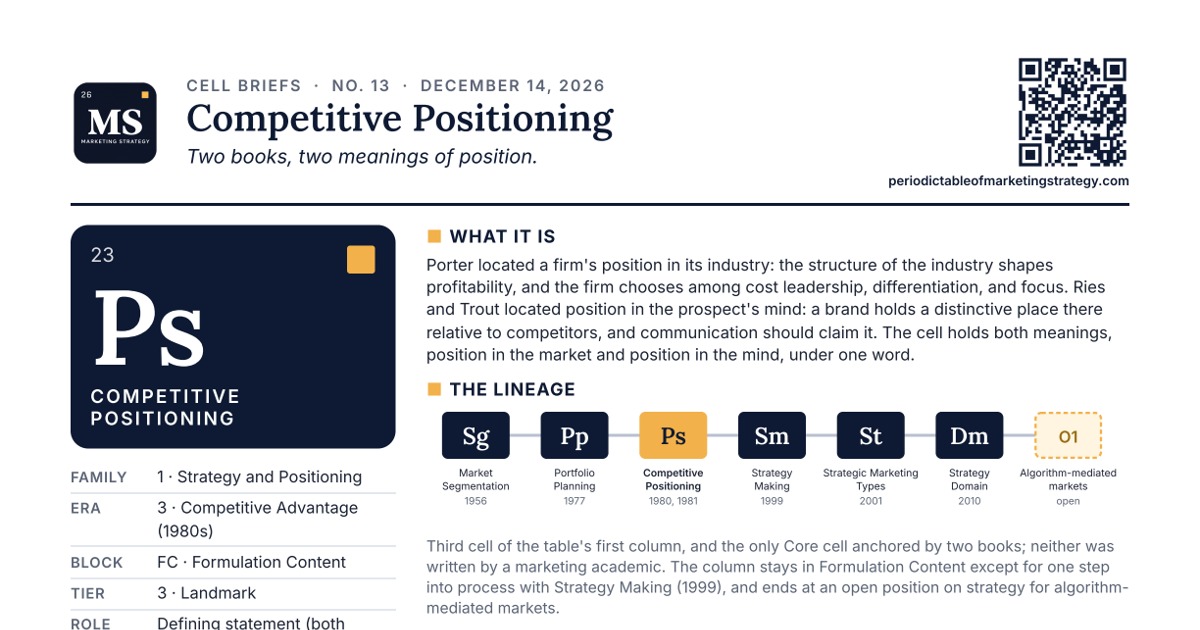
Porter located a firm's position in its industry: the structure of the industry shapes profitability, and the firm chooses among cost leadership, differentiation, and focus. Ries and Trout located position in the prospect's mind: a brand holds a distinctive place there relative to competitors, and communication should claim it. The cell holds both meanings, position in the market and position in the mind, under one word.
The Lineage
- Sg
Market Segmentation
1956
- Pp
Portfolio Planning
1977
- Ps
Competitive Positioning
1980, 1981
- Sm
Strategy Making
1999
- St
Strategic Marketing Types
2001
- Dm
Strategy Domain
2010
- O1
Algorithm-mediated markets
open
Third cell of the table's first column, and the only Core cell anchored by two books; neither was written by a marketing academic. The column stays in Formulation Content except for one step into process with Strategy Making (1999), and ends at an open position on strategy for algorithm- mediated markets.
Where It Travels
Three curated links out: Positional Advantage restates Porter's cost and differentiation positions, Strategy Implementation takes competitive strategy as given, and Global Marketing Strategy borrows configuration and coordination. Nine deep-dive mentions bring the total to 12 links in eight families; four of the nine sit in the brand deep dive.
What It Rests On
Two curated links in: Brand Image (Bi), which positioning extends from product meaning to competitive place, and Product- Market Definition (Pk), which Porter's generic strategies presuppose. Neither book has a reference list in the citation data, so the anchors cite no other anchor works on record.
Descendants You Would Not Guess
Thirty anchor works in 14 families cite the cell. Among them: Pricing Strategy (Tellis, 1986), Satisfaction Index (ACSI) (Fornell, 1992), Enviropreneurial Marketing (Menon and Menon, 1997), Knowledge as an Asset (Glazer, 1991), Loyalty Framework (Dick and Basu, 1994), Working Partnerships (Mohr and Spekman, 1994), and Ecosystems Theory (Adner, 2017; Jacobides, Cennamo, and Gawer, 2018).
Three Things The Cell Does Not Show
- Two readerships that do not overlap. Twenty-six anchor works cite Porter and four cite Ries and Trout; none cites both. All four that cite Ries and Trout are brand cells (brand extension, financial brand valuation, positioning strategy effectiveness).
- Positioning continues in the brand deep dive. In the strategy deep dive the positioning sub-lineage (Trout, 1969; then this cell, with Aaker and Shansby, 1982) has no cell after Kalra and Goodstein (1998) and ends at an open position: positioning when agents compare offerings (D1-O2). Later work on positioning and differentiation sits in four brand cells instead.
- Porter is cited where the cell is not linked. Porter (1980) ranks second among the Core works of the 1980s by citations per year, behind SERVQUAL. Its citing works include the ACSI, enviropreneurial marketing, and ecosystems theory, none of which the link data connect to this cell.
Anchor Works
Cite as: Hult, G. Tomas M. (2026), “Competitive Positioning,” Cell Briefs No. 13, The Periodic Table of Marketing Strategy.
Link counts and citing works are from the site's analysis dataset (Version 1.0). Placements, anchors, and tiers are editorial judgments; verify against the original works.
Copyright © G. Tomas M. Hult 2026