
What It Is
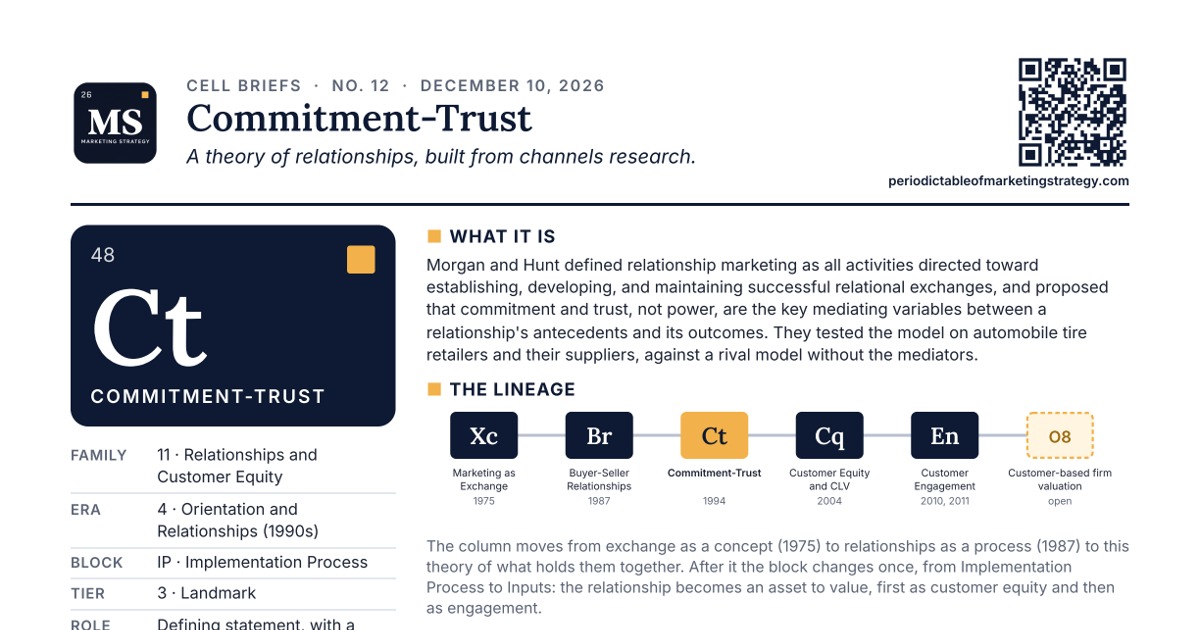
Morgan and Hunt defined relationship marketing as all activities directed toward establishing, developing, and maintaining successful relational exchanges, and proposed that commitment and trust, not power, are the key mediating variables between a relationship's antecedents and its outcomes. They tested the model on automobile tire retailers and their suppliers, against a rival model without the mediators.
The Lineage
- Xc
Marketing as Exchange
1975
- Br
Buyer-Seller Relationships
1987
- Ct
Commitment-Trust
1994
- Cq
Customer Equity and CLV
2004
- En
Customer Engagement
2010, 2011
- O8
Customer-based firm valuation
open
The column moves from exchange as a concept (1975) to relationships as a process (1987) to this theory of what holds them together. After it the block changes once, from Implementation Process to Inputs: the relationship becomes an asset to value, first as customer equity and then as engagement.
Where It Travels
Four curated links out, to four families: Market-Based Assets, Service-Dominant Logic, Opportunism Management, and CRM Process. Seven deep-dive mentions follow the words trust and commitment into channels (trust in exchange, interdependence, working partnerships, trust at multiple levels), satisfaction (complaint handling justice, word-of-mouth antecedents), and brand trust and affect.
What It Rests On
Two curated links in: Services Marketing (Sx), whose relationship construct it generalizes to all exchange, and the channels cells Channel Behavior and Channel Political Economy. The anchor cites 14 other anchor works, six of them channels papers, among them Anderson and Narus (1990), Heide and John (1992), and Hunt and Nevin (1974), plus Dwyer, Schurr, and Oh (1987).
Descendants You Would Not Guess
Forty-four anchor works in 13 families cite it, tied for sixth among the 98 cells. Some are far from relationships: Resource-Advantage Theory (Hunt and Morgan, 1995), CSR and Market Value (Luo and Bhattacharya, 2006), Brand Community (McAlexander, Schouten, and Koenig, 2002), Normative Marketing Ethics (Laczniak and Murphy, 2019), and both 2020 revisions of the Uppsala Model (Hult, Gonzalez-Perez, and Lagerström, 2020; Vahlne and Johanson, 2020).
Three Things The Cell Does Not Show
- A channels paper by ancestry. Six of the 14 anchor works it cites are channels papers, and five of its 11 documented links lead back to the channels column. The best-known theory of relationship marketing was assembled largely from research on power, conflict, and dependence between firms.
- The top of its decade. By citations per year it is first among the 26 Core works of the 1990s, ahead of Keller (1993) and Narver and Slater (1990), and in the 99th percentile of all 1990s works.
- Trust moves from mediator to outcome. In the deep dive the sub-lineage runs from trust and continuity (Anderson and Weitz, 1989) through this cell to trust, value, and loyalty (Sirdeshmukh, Singh, and Sabol, 2002) and data privacy (Martin, Borah, and Palmatier, 2017): process becomes outcome. Open position: trust in algorithmic relationship management (D11-O2).
Anchor Works
Cite as: Hult, G. Tomas M. (2026), “Commitment-Trust,” Cell Briefs No. 12, The Periodic Table of Marketing Strategy.
Link counts and citing works are from the site's analysis dataset (Version 1.0). Placements, anchors, and tiers are editorial judgments; verify against the original works.
Copyright © G. Tomas M. Hult 2026