
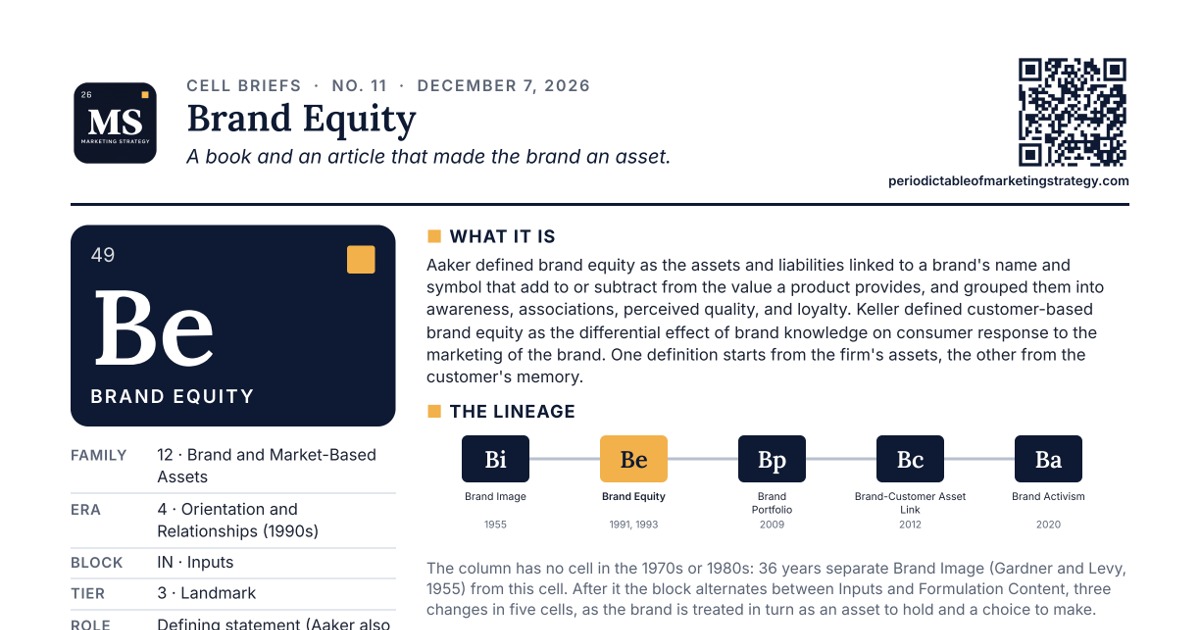
What It Is
Aaker defined brand equity as the assets and liabilities linked to a brand's name and symbol that add to or subtract from the value a product provides, and grouped them into awareness, associations, perceived quality, and loyalty. Keller defined customer-based brand equity as the differential effect of brand knowledge on consumer response to the marketing of the brand. One definition starts from the firm's assets, the other from the customer's memory.
The Lineage
- Bi
Brand Image
1955
- Be
Brand Equity
1991, 1993
- Bp
Brand Portfolio
2009
- Bc
Brand-Customer Asset Link
2012
- Ba
Brand Activism
2020
The column has no cell in the 1970s or 1980s: 36 years separate Brand Image (Gardner and Levy, 1955) from this cell. After it the block alternates between Inputs and Formulation Content, three changes in five cells, as the brand is treated in turn as an asset to hold and a choice to make.
Where It Travels
Five curated links out, level with Service Quality and behind only Market Orientation, Marketing Mix, and Positional Advantage. Three go to the marketing-finance column (Market-Based Assets, Productivity Chain, Performance Outcomes); the others go to Customer Equity and CLV and Customer Experience. Two deep-dive mentions add sustainable advantage in services and perceived brand globalness.
What It Rests On
One curated link in, from Positional Advantage (Pa): the brand as an asset that yields position. Keller cites seven other anchor works, among them Aaker and Keller (1990) on brand extensions, Day, Shocker, and Srivastava (1979), Park, Jaworski, and MacInnis (1986), and Zeithaml (1988). Aaker's book has no reference list in the citation data.
Descendants You Would Not Guess
Thirty anchor works in nine families cite the cell, half of them outside the brand deep dive: Market-Based Assets (Srivastava, Shervani, and Fahey, 1998), Satisfaction and Firm Value (Fornell et al., 2006), Strategy Domain (Varadarajan, 2010), Corporate Associations (Brown and Dacin, 1997), Marketing Resource Redeployment (Capron and Hulland, 1999), CRM Roadmap (Boulding et al., 2005), and Long-Term Strategy Effects (Ataman, van Heerde, and Mela, 2010).
Three Things The Cell Does Not Show
- Two definitions, one cell. Aaker counts assets from the firm's side; Keller measures knowledge from the customer's side. The cell holds both, and the deep dive adds a third: brand value estimated from scanner data (Kamakura and Russell, 1993).
- Most of the citation weight is Keller's. Keller (1993) is cited by 26 anchor works and Aaker (1991) by seven. By citations per year the article ranks second among the 26 Core works of the 1990s, behind Morgan and Hunt (1994).
- The measurement story is in the deep dive. Brand Equity Measurement (Ailawadi, Lehmann, and Neslin, 2003; Keller and Lehmann, 2006; Yoo and Donthu, 2001) follows this cell there, then the alignment of consumer- and sales-based equity (Datta, Ailawadi, and van Heerde, 2017). The open position: brand equity measured from digital traces (D12-O2).
Anchor Works
Cite as: Hult, G. Tomas M. (2026), “Brand Equity,” Cell Briefs No. 11, The Periodic Table of Marketing Strategy.
Link counts and citing works are from the site's analysis dataset (Version 1.0). Placements, anchors, and tiers are editorial judgments; verify against the original works.
Copyright © G. Tomas M. Hult 2026