
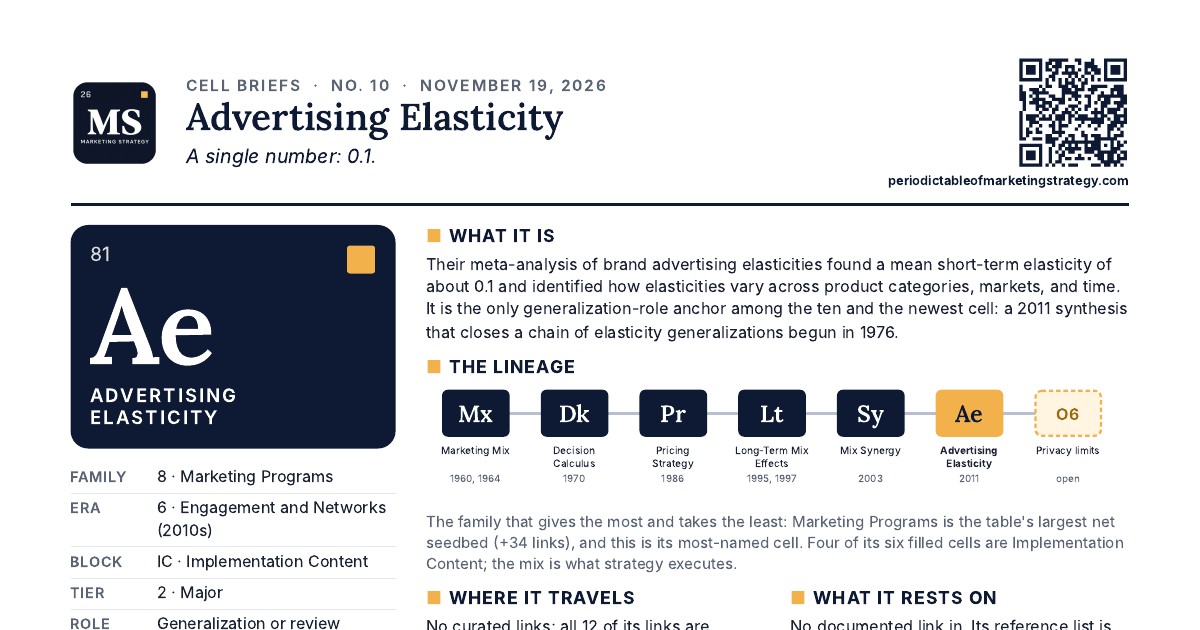
What It Is
Their meta-analysis of brand advertising elasticities found a mean short-term elasticity of about 0.1 and identified how elasticities vary across product categories, markets, and time. It is the only generalization-role anchor among the ten and the newest cell: a 2011 synthesis that closes a chain of elasticity generalizations begun in 1976.
The Lineage
- Mx
Marketing Mix
1960, 1964
- Dk
Decision Calculus
1970
- Pr
Pricing Strategy
1986
- Lt
Long-Term Mix Effects
1995, 1997
- Sy
Mix Synergy
2003
- Ae
Advertising Elasticity
2011
- O6
Privacy limits
open
The family that gives the most and takes the least: Marketing Programs is the table's largest net seedbed (+34 links), and this is its most-named cell. Four of its six filled cells are Implementation Content; the mix is what strategy executes.
Where It Travels
No curated links; all 12 of its links are mentions, and they cluster where the elasticity question went next: six in Digital, Data, and Technology (web advertising response, sponsored search, retargeting, mobile targeting, privacy regulation, the personalization paradox) and three in Marketing-Finance (systematic risk, event studies, myopic management). The question migrated online and to Wall Street.
What It Rests On
No documented link in. Its reference list is the lineage itself: Clarke (1976) on the duration of advertising effects, Lambin (1976), Assmus, Farley, and Lehmann (1984), the first elasticity meta-analysis, Tellis (1988), Lodish et al. (1995), Vakratsas and Ambler (1999), and Bijmolt, van Heerde, and Pieters (2005) on price elasticities. A generalization built on generalizations.
Descendants You Would Not Guess
Seven anchor works in four families cite it, and three of them are meta-analyses: Marketing's Impact on Firm Value (Edeling and Fischer, 2016), When Does Market Share Matter (Edeling and Himme, 2018), and Building, Measuring, and Profiting from Customer Loyalty (Watson et al., 2015). The others: Brand-Customer Asset Link (Stahl et al., 2012), Advertising Channel Effectiveness (Danaher and Dagger, 2013), Integrating Marketing Communications (Batra and Keller, 2016), and consumer- versus sales-based brand equity (Datta, Ailawadi, and van Heerde, 2017).
Three Things The Cell Does Not Show
- Named, never sourced. It is one of nine Core cells with no curated link in either direction, and seven of its twelve mentions come from cells that predate it. Its vocabulary, advertising response, traveled before the generalization did.
- The longest lag among the ten. Sixty-one years separate the family's first defining statement (Dean, 1950, on new product pricing) from this generalization. Marketing Programs defined first and generalized last.
- The frontier is privacy. Open position O6, Mix response under privacy limits, extends Long-Term Mix Effects, Mix Synergy, and this cell. The next elasticity question is what advertising does when tracking and attribution are constrained.
Anchor Works
Cite as: Hult, G. Tomas M. (2026), “Advertising Elasticity,” Cell Briefs No. 10, The Periodic Table of Marketing Strategy.
Link counts and citing works are from the site's analysis dataset (Version 1.0). Placements, anchors, and tiers are editorial judgments; verify against the original works.
Copyright © G. Tomas M. Hult 2026